
AI in autonomous vehicles is the real “autopilot”—forget sci-fi, it’s already taking the wheel using sensors, cameras, and deep learning. These self-driving brains process live data, spotting cyclists, potholes, or that one guy ignoring crosswalks. Neural networks handle lane-keeping like pros, while prediction models try to outthink reckless drivers. Engineers keep fine-tuning with relentless testing and simulations, because nobody wants their car channeling HAL 9000. Curious how it all keeps getting smarter (and, ideally, safer)?
Let’s be honest: the idea of cars driving themselves still feels like something straight out of a sci-fi movie marathon, right between sentient robots and time-traveling DeLoreans. Yet, here we are—real-world engineers are handing the wheel to artificial intelligence, and it’s more “now” than “next century.”
At the core, AI is the brain behind autonomous vehicles, letting them operate with zero human input (unless your dog is secretly a programmer). This isn’t just about pressing “autopilot” and hoping for the best; it involves serious machine learning wizardry. The combination of AI, hardware, and software is essential for true autonomy—without all three working in sync, a car can’t safely or reliably drive itself. Simulation offers a safer alternative for early testing phases when engineers want to validate how an AI vehicle might behave in risky scenarios.
AI is the real driver in autonomous cars—no humans needed, just heaps of machine learning magic behind the wheel.
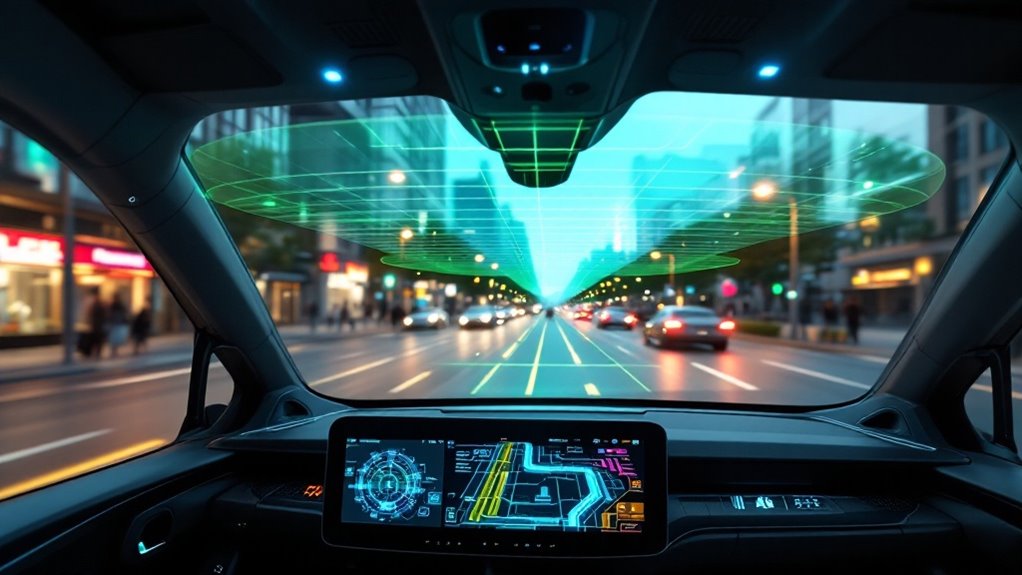
AI’s main jobs? Perception, decision-making, and control—in other words, seeing the world, figuring out what’s happening, and actually driving, all in real time. Picture a car packed with sensors: lidar, radar, cameras, GPS, you name it. These gadgets are the car’s senses, beaming in raw data. AI then uses deep learning—fancy stuff like convolutional neural networks (CNNs)—to turn those blips and blobs into a real-time map of the world. It’s like your car binge-watching “Stranger Things” and then explaining the plot in detail.
Perception systems are the unsung heroes here. They fuse data from a smorgasbord of sensors, letting vehicles spot everything from lost dogs to erratic cyclists. Computer vision algorithms are constantly on the lookout, updating the car’s internal world map faster than you can say “merge left.”
- Lane detection? Absolutely essential. Neural networks such as line-CNN and Tesla’s Hydranet analyze road markings, helping cars stay in their lane—even when life throws a curveball (or a pothole).
- Prediction models, like Nvidia’s predictionNet, are the car’s crystal ball, forecasting where other road users might go next. Outputs from these models keep your ride collision-free and smooth.
Ultimately, AI juggles perception, prediction, and planning—calculating safe, legal, and (hopefully) comfortable routes. Decisions are refined by reinforcement learning, where the car learns from trial, error, and simulated disasters.
Testing and validation never stop, because, let’s face it, nobody wants a real-life “Maximum Overdrive.”